idea for architect
Architectural & Design
Monday, August 2, 2010
Canton TV Tower
Sunday, August 1, 2010
Datong Twin Towers / Plasma Studio
Plasma Studio’s newest project in China, a bold angular set of towers, speaks to the firm’s geometric obsession. The project was recently awarded first prize in an invited competition in Datong, Shanxi province. The mix-use complex, measuring of 70,000 m2, will include a hotel in one tower and offices in the other. Running along a highly trafficked street, the towers create a strong presence along the streetscape and are pulled away just enough from the site’s edge to provide places for pedestrians and greenery.
More about the awarded project after the break.
The towers include a central light well and the spaces surrounding the well, sectionally, are shared public spaces. On the lowest level, the common public lobby begins this thread of public spaces which ends in an accessible roofscape. The interior geometry will create overlapping moments that will enhance an activated floor plan.
The towers’ inner cores assist in the low-energy ventilation design which- in alignment to a parametric differentiated facade concept- seeks to minimize energy use and maximize ambiant quality and expression.
More about the awarded project after the break.
The towers include a central light well and the spaces surrounding the well, sectionally, are shared public spaces. On the lowest level, the common public lobby begins this thread of public spaces which ends in an accessible roofscape. The interior geometry will create overlapping moments that will enhance an activated floor plan.
The towers’ inner cores assist in the low-energy ventilation design which- in alignment to a parametric differentiated facade concept- seeks to minimize energy use and maximize ambiant quality and expression.
Woermann Tower Posted by Honey
Woermann Tower in Palmas de Canaria, Spain by Abalos & Herreros. Unfortunately, the site is all in Spanish so I can’t understand much of it but the images are enough to keep me intrigued.
sweet-station.com
The New Dance and Music Centre in The Hague by Zaha Hadid Architects
2010

Zaha Hadid Architects have unveiled this design for a performing arts centre in The Hague, the Netherlands.

The new centre would house four music and dance institutions in one building clad with horizontal louvres.

The design is one of three shortlisted proposals for the site, along with Amsterdam architects RAU and Rotterdam studio Neutelings Riedijk Architecten. The winning project will be announced in November 2010.

More about Zaha Hadid in our special category.
Here’s some more information from Zaha Hadid Architects:
New Dance and Music Centre in The Hague, The Netherlands The New Dance and Music Centre in The Hague houses four major institutions in one single envelope (the Royal Conservatory, The Netherlands Dance Theatre, the Residential Orchestra and the centre’s Guest Programming).

The design concept is developed from an understanding of the unique urban dynamics of the site, resulting in subtle volumetric gestures that invite the public domain from the plaza at ground level into the heart of the building, reinforcing the public character of the combined institutions and culminating with a gracious curving roofline that neatly nests itself within the city skyline.

In sharp contrast with the centre’s basic rectangular geometry, a fluid force field of horizontal louvers – that seemingly moves when graced by light and shadow – creates a playful language on the facade that articulates public circulation, foyers and the sculpted inner atrium, whilst at the same time allows visual connections out to the square as well as internal links between the various spaces of the project.
Zaha Hadid Architects have unveiled this design for a performing arts centre in The Hague, the Netherlands.
The new centre would house four music and dance institutions in one building clad with horizontal louvres.
The design is one of three shortlisted proposals for the site, along with Amsterdam architects RAU and Rotterdam studio Neutelings Riedijk Architecten. The winning project will be announced in November 2010.
More about Zaha Hadid in our special category.
Here’s some more information from Zaha Hadid Architects:
New Dance and Music Centre in The Hague, The Netherlands The New Dance and Music Centre in The Hague houses four major institutions in one single envelope (the Royal Conservatory, The Netherlands Dance Theatre, the Residential Orchestra and the centre’s Guest Programming).
The design concept is developed from an understanding of the unique urban dynamics of the site, resulting in subtle volumetric gestures that invite the public domain from the plaza at ground level into the heart of the building, reinforcing the public character of the combined institutions and culminating with a gracious curving roofline that neatly nests itself within the city skyline.
In sharp contrast with the centre’s basic rectangular geometry, a fluid force field of horizontal louvers – that seemingly moves when graced by light and shadow – creates a playful language on the facade that articulates public circulation, foyers and the sculpted inner atrium, whilst at the same time allows visual connections out to the square as well as internal links between the various spaces of the project.
Mountains and Opening House by EASTERN Design Office
2010

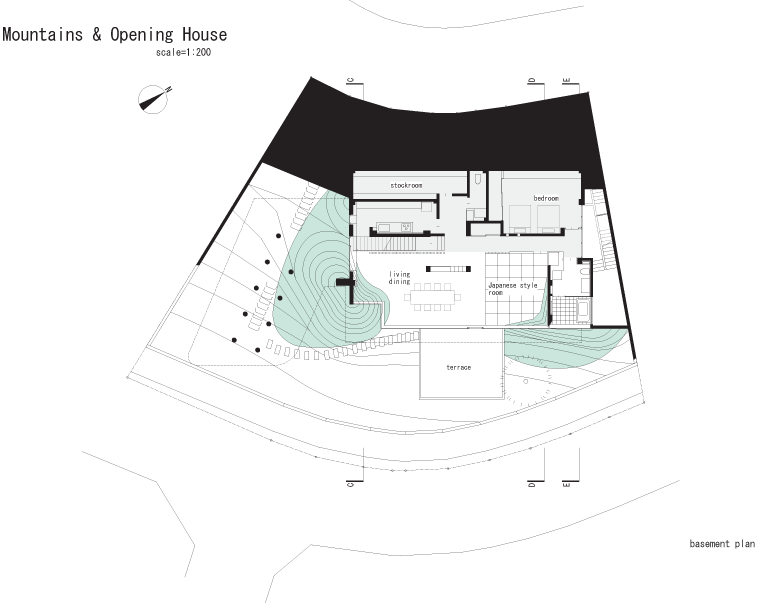
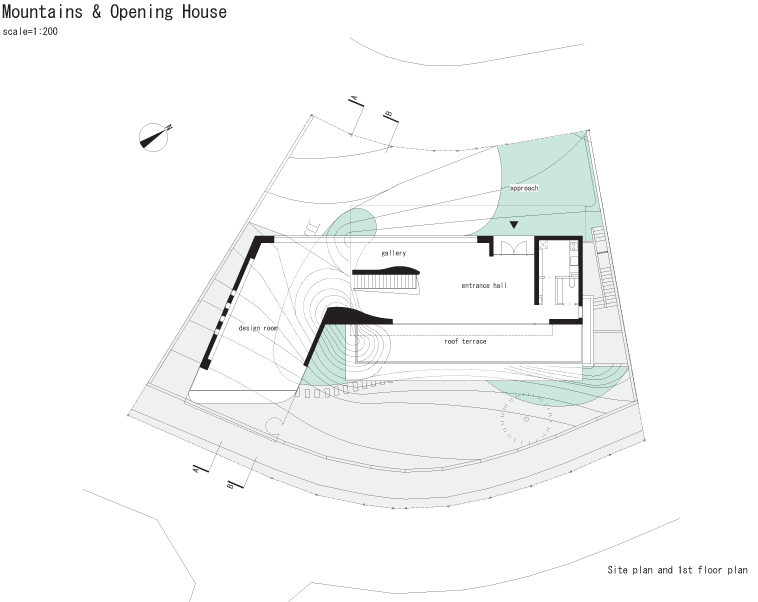
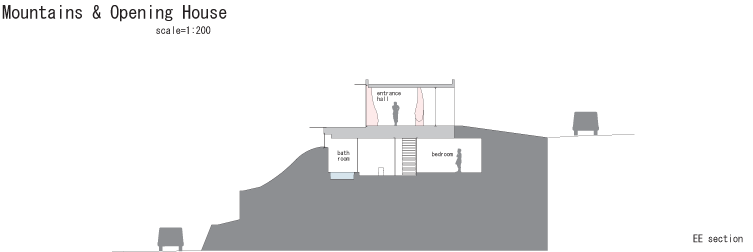
This house in Takarazuka city by Japanese architects EASTERN Design Office has a studio supported above the residence on two mounds of crushed marble.

Called Mountains and Opening House, the project on a sloping site is a home and studio for a footwear designer.

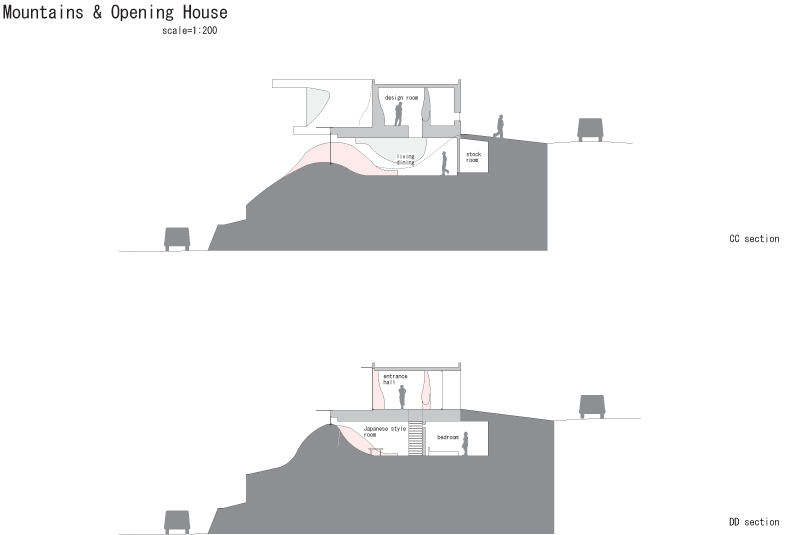
The living areas are on the lower floor, sheltered on three sides by the earth of the sloping site.

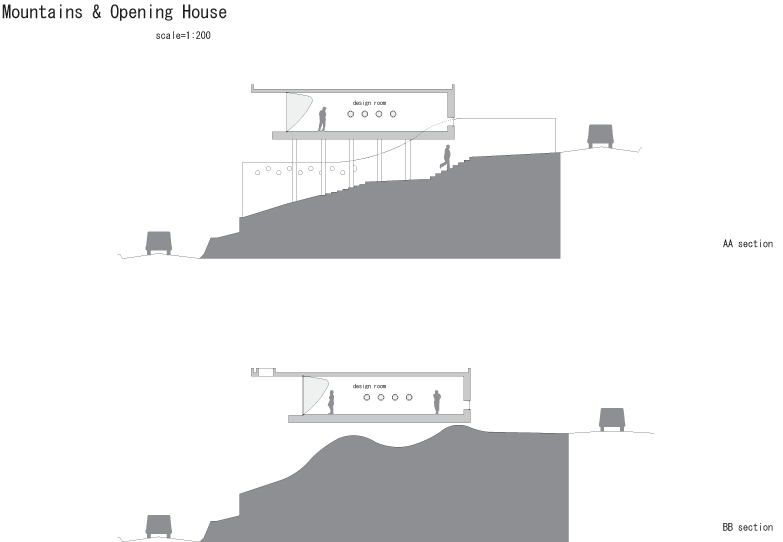
Meanwhile the studio above cantilevers out and overlooks the Osaka Plain.

More about EASTERN Design Office on Dezeen:
Horizontal House (October 2009)
Slit Court (October 2009)
MON Factory/House (October 2009)
Slit House (October 2009)

Photographs are by Koichi Torimura.

Here’s some more information from the architects:
Mountain/Opening Deck on the Mountain
The Material of the Mountain
The outside (exterior) mountain is formed into a mound by piling up soil excavated from the slope. The surface of the mound is a type of raw material made from crushed marble called “Kansui”. Glittering fragments of crushed marble on a whity surface shine brilliantly. There are two white mountains. The living quarters are inside the white mountain while atop the white mountainous wave is a deck.

One of the two white mountains functions as a structural support for this building, while the other mountain conceals the bathroom. These two mountains are also set into the living spaces of the residential quarters.

The Structure of the Deck
The framework of the upper floor is steel and the lower floor is reinforced concrete. The upper floor evokes a sense of being on the deck of a boat and in order to achieve this feeling architectural columns and walls are designed as to make one unaware of their existence.

Entering the house from the northern road, a 14meter wide opening and the 16.5 meter x3 meter terrace outside create the feeling that your own body is floating in the scenery. This is a deck.

To achieve this, we used two different methods.

Living Space + Opening + Mountain
The lower floor fully utilizes the slope of the mountain. The hidden areas become mountains、while the areas that is required light become valleys. These rolling undulations are all part of the design.

Two Horizontal Eaves
There are two thin iron plate eaves on the openings: one with the length of 14 meters on the upper floor and the other with 16.5 meters on the lower floor.

The upper and lower floors are used in different ways. The upper floor is a design room.The lower floor houses residential quarters. That is there are public spaces within the residential quarters.

The demand of how the spaces should be is different; therefore, the structure is also different.

Click above for larger image
Taking balance to unify the upper and lower portions, the curves of the mountain are made continuous with the curves of the openings.

Click above for larger image
There are two thin iron plate eaves on the openings: one with the length of 14 meters on the upper floor and the other with 16.5 meters on the lower floor.

Click above for larger image
The thickness of the iron plate is only 9mm. The straight line of these two eaves emphasizes the expansive spreading horizontal width of this house. Consequently, this makes you forget that the house is on a sloped site.

Click above for larger image
Blue and White
The overall whiteness is not just a general white coat of paint. It is white mixed with blue.

Click above for larger image
This is because we want white that corresponds with the blue sky. In addition, we intend this white to reflect the light of fragments of marble scattered in the raw material which covers on the surface of two newly built mountains.
Anna Nakamura+Taiyo Jinno/EASTERN design office
This house in Takarazuka city by Japanese architects EASTERN Design Office has a studio supported above the residence on two mounds of crushed marble.
Called Mountains and Opening House, the project on a sloping site is a home and studio for a footwear designer.
The living areas are on the lower floor, sheltered on three sides by the earth of the sloping site.
Meanwhile the studio above cantilevers out and overlooks the Osaka Plain.
More about EASTERN Design Office on Dezeen:
Horizontal House (October 2009)
Slit Court (October 2009)
MON Factory/House (October 2009)
Slit House (October 2009)
Photographs are by Koichi Torimura.
Here’s some more information from the architects:
Mountain/Opening Deck on the Mountain
The Material of the Mountain
The outside (exterior) mountain is formed into a mound by piling up soil excavated from the slope. The surface of the mound is a type of raw material made from crushed marble called “Kansui”. Glittering fragments of crushed marble on a whity surface shine brilliantly. There are two white mountains. The living quarters are inside the white mountain while atop the white mountainous wave is a deck.
One of the two white mountains functions as a structural support for this building, while the other mountain conceals the bathroom. These two mountains are also set into the living spaces of the residential quarters.
The Structure of the Deck
The framework of the upper floor is steel and the lower floor is reinforced concrete. The upper floor evokes a sense of being on the deck of a boat and in order to achieve this feeling architectural columns and walls are designed as to make one unaware of their existence.
Entering the house from the northern road, a 14meter wide opening and the 16.5 meter x3 meter terrace outside create the feeling that your own body is floating in the scenery. This is a deck.
To achieve this, we used two different methods.
- Revaluation of the trusses. It is not immediately apparent; however, since horizontal slits were cut into the northern wall, trusses were set into it. It is like the structure of a bridge. Bridges are set into the upper part of the horizontal slits which allow the floor to float in the air while concealing the structural device.
- Concealing the structural members in the curves Columns are in the curves forming the openings and this also is concealed. The curves of the openings respond each other with the curves of the mountains. A fantasy created by the repeated curves appearing over and over again.
Living Space + Opening + Mountain
The lower floor fully utilizes the slope of the mountain. The hidden areas become mountains、while the areas that is required light become valleys. These rolling undulations are all part of the design.
Two Horizontal Eaves
There are two thin iron plate eaves on the openings: one with the length of 14 meters on the upper floor and the other with 16.5 meters on the lower floor.
The upper and lower floors are used in different ways. The upper floor is a design room.The lower floor houses residential quarters. That is there are public spaces within the residential quarters.
The demand of how the spaces should be is different; therefore, the structure is also different.
Click above for larger image
Taking balance to unify the upper and lower portions, the curves of the mountain are made continuous with the curves of the openings.
Click above for larger image
There are two thin iron plate eaves on the openings: one with the length of 14 meters on the upper floor and the other with 16.5 meters on the lower floor.
Click above for larger image
The thickness of the iron plate is only 9mm. The straight line of these two eaves emphasizes the expansive spreading horizontal width of this house. Consequently, this makes you forget that the house is on a sloped site.
Click above for larger image
Blue and White
The overall whiteness is not just a general white coat of paint. It is white mixed with blue.
Click above for larger image
This is because we want white that corresponds with the blue sky. In addition, we intend this white to reflect the light of fragments of marble scattered in the raw material which covers on the surface of two newly built mountains.
Anna Nakamura+Taiyo Jinno/EASTERN design office
Virtual Realities by NL Architects
2008

Venice Architecture Biennale: Dutch architects NL present this series of images in the Italian Pavilion at the Venice Architecture Biennale.

Fly United – go with the flow!

Google Forest – the sea levels rise. Less land is available. How can we increase the capacity of our cities?

Flower Power – can we move from what the Dutch call “pollution of the horizon” to “heroic” configurations? Is it possible to create an Eiffel Tower, Atomium or St Louis Arch dedicated to the production of environmentally friendly energy?

Trashberg – the currents of the Pacific Ocean tend to accumulate floating plastic in a confined area. An immense archipelago of trash comes into being, a bouyant island the size of Spain, France and Italy combined.

Minimum Speed 200 kh/h – the products that surround us often have unused capacities, we only use a fraction of their potential.

Phantom Pain – in the capitals of Europe 18 square kms of office space is left unused. This equals more than half of Manhattan. Or a ghost town of 50 twin towers.

Cruise City, City Cruise – cruise ships in theory are “parasites” in every port they call on. Can we introduce a form of reciprocity? Can we imagine a two-way connection between ships and the city?

Venice Architecture Biennale: Dutch architects NL present this series of images in the Italian Pavilion at the Venice Architecture Biennale.
Fly United – go with the flow!
Google Forest – the sea levels rise. Less land is available. How can we increase the capacity of our cities?
Flower Power – can we move from what the Dutch call “pollution of the horizon” to “heroic” configurations? Is it possible to create an Eiffel Tower, Atomium or St Louis Arch dedicated to the production of environmentally friendly energy?
Trashberg – the currents of the Pacific Ocean tend to accumulate floating plastic in a confined area. An immense archipelago of trash comes into being, a bouyant island the size of Spain, France and Italy combined.
Minimum Speed 200 kh/h – the products that surround us often have unused capacities, we only use a fraction of their potential.
Phantom Pain – in the capitals of Europe 18 square kms of office space is left unused. This equals more than half of Manhattan. Or a ghost town of 50 twin towers.
Cruise City, City Cruise – cruise ships in theory are “parasites” in every port they call on. Can we introduce a form of reciprocity? Can we imagine a two-way connection between ships and the city?
FRIEM Headquarters by Onsitestudio
2010

Italian architects Onsitestudio have completed the Milan headquarters of an electrical product manufacturer, wrapped in profiled steel.

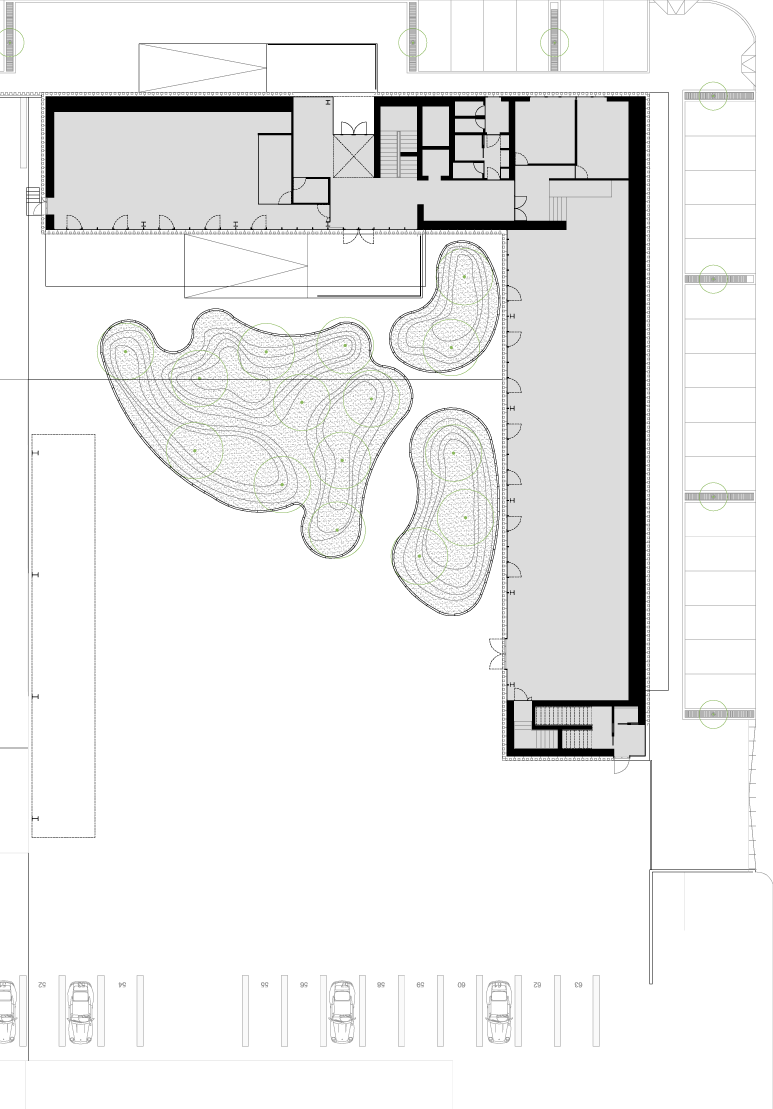
Built in an industrial park, the building’s L-shaped plan creates an enclosed courtyard, filled with birch trees and protected from the neighbouring road.

The steel has been perforated in areas to create shuttering that gives privacy to the research spaces and offices.

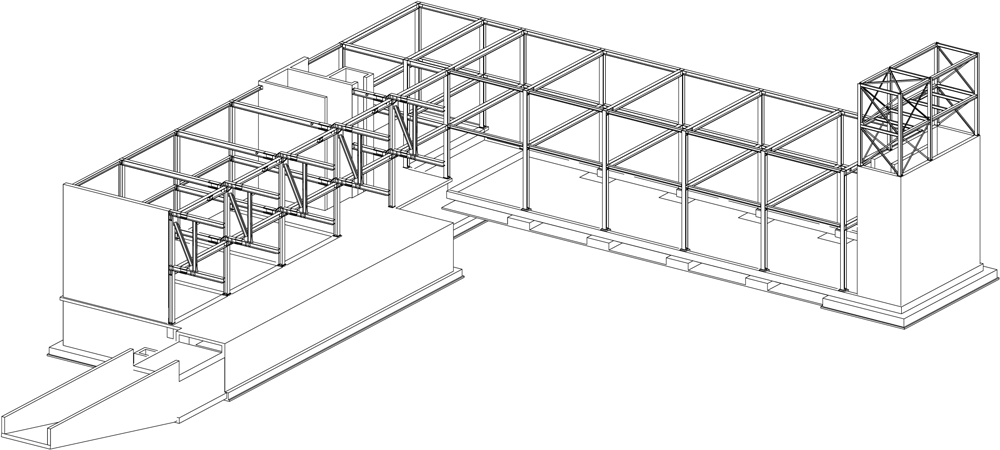
The two storey Friem headquarters have a tower in the far west corner housing services.

Photos are by Helene Binet.
Here’s some more from the architects:
FRIEM Headquarter Segrate (Milan) The main purpose of the project is the overall reorganisation of an area used for the production of electrical converters, located in an industrial compound along the Cassanese state highway, east of Milan.

The main idea is to define the boundaries of the production site by building a continuous wall to create a feeling of an enclosed urban block.

The building “thickens” this wall near the angle, thus separating the internal space from the external one with an internal garden and public spaces along the street .

The project foresees research spaces on the ground floor, withdrawn and facing the internal garden and offices on the second floor.

The volume folds around the angle and stretches out with two bodies, characterized by a continuous glass façade: the first body, facing the birch garden, is designed to be used for directors’ offices, while the second one, facing the street, will be used for the operating offices.

On the far west side, in direction of the state road, the volume becomes a vertical body, with the tower hosting the technical stations.
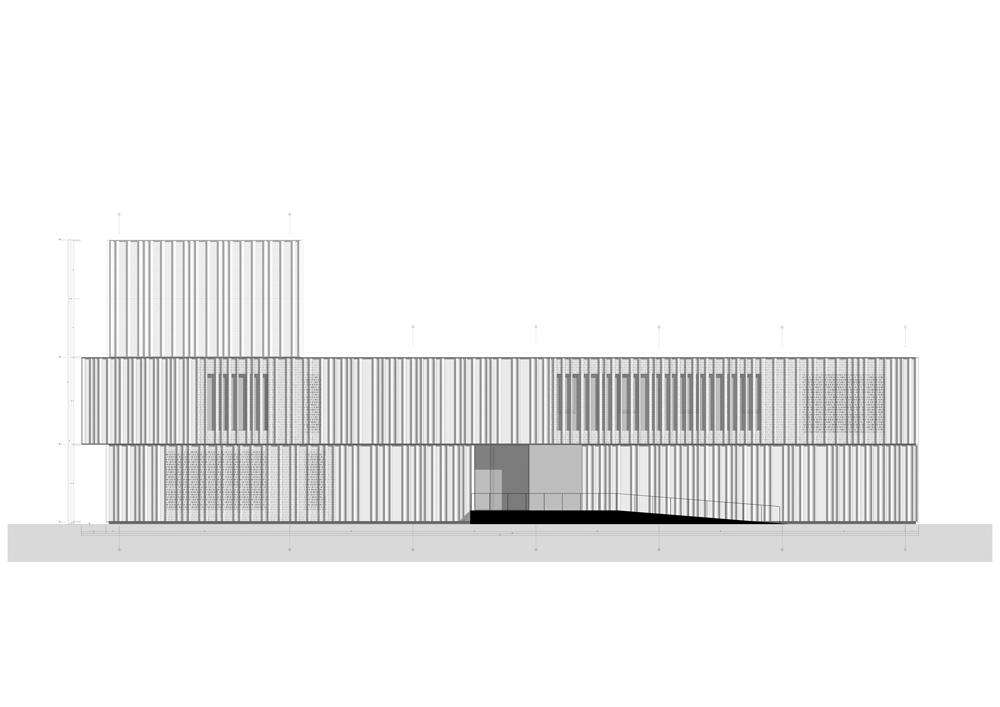
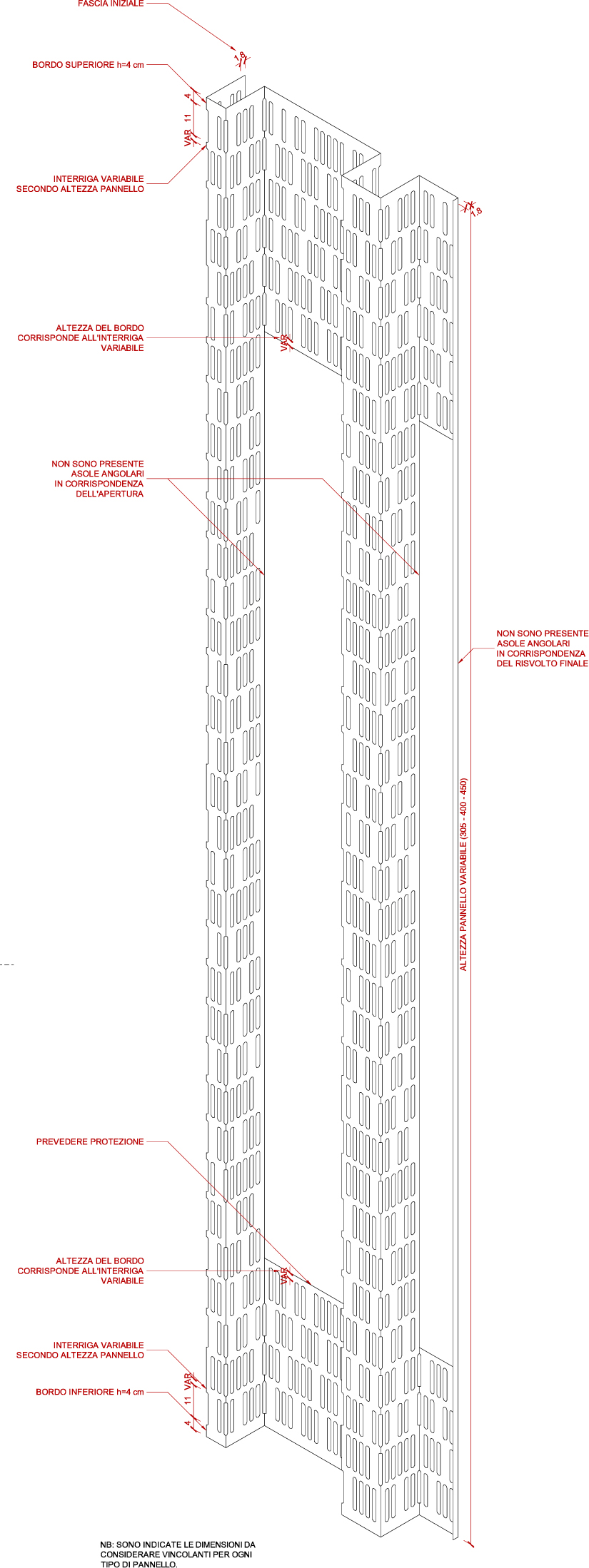
The metal skin, constituted by shaped and drilled sheet metal in opaque stainless steel, envelopes the building entirely like a curtain, thus conferring to the volume a balanced character, where the opaque and transparent portions are ambiguously defined.

The skin filters the light into the building at different opening degrees, depending on the exposure to the sun and the degree of intimacy desired in the interior.
As compared to indistinctly open spaces, generally used for the buildings for the tertiary sector or to the anonymous forms standing in the background of large coloured signs, which are typically of the suburban areas of European cities, the general perception is of a substantially homogenous building, whose unique character derives from the complexity of the covering.

In this sense, the building tries to find a balance between the identity purpose of FRIEM and a general urban attitude defining rules and hierarchies. The texture of the metal facing was developed in several phases, starting with standard industrial parts, like elongated, drilled and bent plates, in order to create a solution specifically designed to convey the idea of a varied covering both at a layout and visual level.

The self-supporting elements with mechanical attachment at the ends have different widths and height varying from 4 to 4.5 meters. The selected sheet metal is AISI 304 stainless steel with a thickness of 2 mm, press-formed with custom openings cut by lasers with fine brushed finish.

The contrast between the apparent monolithic purpose and its detailed organisation, participates to the abstraction effort on which all the project is based and confers to it a particular and recognizable identity.

The operating offices are located near the two glass façades, in front of the internal garden and towards the outside. In correspondence of some of the ambiences, the covering has been further dilated in order to re- establish a relationship with the landscape.

In contrast with the perpendicular form of the main building, the garden occupies the spaces between the two bodies and the existing productive part through more organic forms such as planted birch and Convallaria trees.

The intent of the chosen essences, is to create a further filter between outside-facing offices and operating areas and convey clients, customers and workers towards defined routes.
Despite its penalizing configuration and the demanding relation between transparent and opaque parts, the building is designed to meet the class A energy efficiency requirements of CENED.

At present the metal covering has not yet been implemented, though it has already been prepared to be covered with photovoltaic panels in amorphous silica.
Energy efficiency is achieved through several strategies: a high performance covering system for both opaque and transparent portions, external shielding systems against solar radiation, internal curtains, technical systems based on heat pumps and the recovery of rain water for irrigation.

The thermo refrigerating station, located in the technical tower, is based on two heat pumps, respectively used as spare pump and at 60%, with an outdoor boiler that is designed to be used in winter only in the event of failure of both main units.

The summer/winter air conditioning system is based on fan coil units installed in the false ceiling. The thermal carrier liquid is distributed by means of a 4 pipe circuit, with standalone ducts and pumping units.
The heat pumps supply also the cooling and/or heating battery of the air processing unit, located in the basement, through secondary circuits.

The water and air sealing layer, situated behind the metal cover, is constituted by opaque and transparent parts. The first ones are constituted by curtain walls and aluminium thermal-break windows with high performance double glazing.

More specifically, the external sheet, with a thickness of 8 mm, is hardened with an H.S.T. treatment, the dead air space with a thickness of 16 is filled with argon gas, while the internal stratified plate with a thickness of 4+4 mm has interlayers in acoustic pvb and low emissions. The transmittance of the glass panels is equivalent to Ug=1.1 W/m2K, while the noise reduction, which is particularly important due to the closeness of the building to an airport, is 42 dB.

Click above for larger image
Stratigraphy is organised as follows: a sandwich panel in wood and mineral wool with a thickness of 150 mm, coupled on the outside with a transpiring, watertight and UV resistant membrane, and completed on the inside by an insulated wall lining in plaster with 3 plates. The overall transmittance of the above-described assembly is U=0.058 W/m2K

Click above for larger image
The construction choices, like the metal hardware, the facade systems and the dry partitions are designed to be easily managed during the execution phase. The simplicity of execution and easiness of installation of the construction systems on-site have enabled to clearly define the works, give preference to systems that could be assembled in dry conditions and reduce storage space.

Click above for larger image
This approach has reduced constructiontime and improved its quality thanks to the possibility of carrying out the machining operations off-site, regardless of the atmospheric conditions of the yard. In the internal spaces the light seeps through the metallic texture of the covering.

Click above for larger image
The purpose of these devices is to control light and create at the same time an internal atmosphere of intimacy and confidentiality. The zenithal light prevails in the entrance area. In order to create a direct relationship with the outside, and also for regulatory purposes, some spaces have been fitted with large glass walls.
The aim was to create an ambiguous relation between the opaque and transparent portions, both indoors and outdoors, by adopting a solution that is both a wall and curtain and sunbreaker.

Client Friem S.p.A.
Site Via Edison, 1 – 20090 Segrate (Milan – Italy)
Design: onsitestudio architects: Angelo Lunati, Luca Varesi design team: Thilo de Gregorio, Roberto Lamanna, Rossella Locatelli, Francesco Marilli, Mariana Sendas, Giulia Vrespa
Data design: December 2007 – July 2008 construction: December 2008 – April 2009 total area: 10.270 mq building surface: 2.100 mq
In collaboration with CeAS S.r.l. (structural engineering) Primeco S.r.l. – Danilo Cavecchia (mechanical engineering) Primeco S.r.l. – Enrico Riccardi (electrical enigineering)
Photographs Helene Binet
Italian architects Onsitestudio have completed the Milan headquarters of an electrical product manufacturer, wrapped in profiled steel.
Built in an industrial park, the building’s L-shaped plan creates an enclosed courtyard, filled with birch trees and protected from the neighbouring road.
The steel has been perforated in areas to create shuttering that gives privacy to the research spaces and offices.
The two storey Friem headquarters have a tower in the far west corner housing services.
Photos are by Helene Binet.
Here’s some more from the architects:
FRIEM Headquarter Segrate (Milan) The main purpose of the project is the overall reorganisation of an area used for the production of electrical converters, located in an industrial compound along the Cassanese state highway, east of Milan.
The main idea is to define the boundaries of the production site by building a continuous wall to create a feeling of an enclosed urban block.
The building “thickens” this wall near the angle, thus separating the internal space from the external one with an internal garden and public spaces along the street .
The project foresees research spaces on the ground floor, withdrawn and facing the internal garden and offices on the second floor.
The volume folds around the angle and stretches out with two bodies, characterized by a continuous glass façade: the first body, facing the birch garden, is designed to be used for directors’ offices, while the second one, facing the street, will be used for the operating offices.
On the far west side, in direction of the state road, the volume becomes a vertical body, with the tower hosting the technical stations.
The metal skin, constituted by shaped and drilled sheet metal in opaque stainless steel, envelopes the building entirely like a curtain, thus conferring to the volume a balanced character, where the opaque and transparent portions are ambiguously defined.
The skin filters the light into the building at different opening degrees, depending on the exposure to the sun and the degree of intimacy desired in the interior.
As compared to indistinctly open spaces, generally used for the buildings for the tertiary sector or to the anonymous forms standing in the background of large coloured signs, which are typically of the suburban areas of European cities, the general perception is of a substantially homogenous building, whose unique character derives from the complexity of the covering.
In this sense, the building tries to find a balance between the identity purpose of FRIEM and a general urban attitude defining rules and hierarchies. The texture of the metal facing was developed in several phases, starting with standard industrial parts, like elongated, drilled and bent plates, in order to create a solution specifically designed to convey the idea of a varied covering both at a layout and visual level.
The self-supporting elements with mechanical attachment at the ends have different widths and height varying from 4 to 4.5 meters. The selected sheet metal is AISI 304 stainless steel with a thickness of 2 mm, press-formed with custom openings cut by lasers with fine brushed finish.
The contrast between the apparent monolithic purpose and its detailed organisation, participates to the abstraction effort on which all the project is based and confers to it a particular and recognizable identity.
The operating offices are located near the two glass façades, in front of the internal garden and towards the outside. In correspondence of some of the ambiences, the covering has been further dilated in order to re- establish a relationship with the landscape.
In contrast with the perpendicular form of the main building, the garden occupies the spaces between the two bodies and the existing productive part through more organic forms such as planted birch and Convallaria trees.
The intent of the chosen essences, is to create a further filter between outside-facing offices and operating areas and convey clients, customers and workers towards defined routes.
Despite its penalizing configuration and the demanding relation between transparent and opaque parts, the building is designed to meet the class A energy efficiency requirements of CENED.
At present the metal covering has not yet been implemented, though it has already been prepared to be covered with photovoltaic panels in amorphous silica.
Energy efficiency is achieved through several strategies: a high performance covering system for both opaque and transparent portions, external shielding systems against solar radiation, internal curtains, technical systems based on heat pumps and the recovery of rain water for irrigation.
The thermo refrigerating station, located in the technical tower, is based on two heat pumps, respectively used as spare pump and at 60%, with an outdoor boiler that is designed to be used in winter only in the event of failure of both main units.
The summer/winter air conditioning system is based on fan coil units installed in the false ceiling. The thermal carrier liquid is distributed by means of a 4 pipe circuit, with standalone ducts and pumping units.
The heat pumps supply also the cooling and/or heating battery of the air processing unit, located in the basement, through secondary circuits.
The water and air sealing layer, situated behind the metal cover, is constituted by opaque and transparent parts. The first ones are constituted by curtain walls and aluminium thermal-break windows with high performance double glazing.
More specifically, the external sheet, with a thickness of 8 mm, is hardened with an H.S.T. treatment, the dead air space with a thickness of 16 is filled with argon gas, while the internal stratified plate with a thickness of 4+4 mm has interlayers in acoustic pvb and low emissions. The transmittance of the glass panels is equivalent to Ug=1.1 W/m2K, while the noise reduction, which is particularly important due to the closeness of the building to an airport, is 42 dB.
Click above for larger image
Stratigraphy is organised as follows: a sandwich panel in wood and mineral wool with a thickness of 150 mm, coupled on the outside with a transpiring, watertight and UV resistant membrane, and completed on the inside by an insulated wall lining in plaster with 3 plates. The overall transmittance of the above-described assembly is U=0.058 W/m2K
Click above for larger image
The construction choices, like the metal hardware, the facade systems and the dry partitions are designed to be easily managed during the execution phase. The simplicity of execution and easiness of installation of the construction systems on-site have enabled to clearly define the works, give preference to systems that could be assembled in dry conditions and reduce storage space.
Click above for larger image
This approach has reduced constructiontime and improved its quality thanks to the possibility of carrying out the machining operations off-site, regardless of the atmospheric conditions of the yard. In the internal spaces the light seeps through the metallic texture of the covering.
Click above for larger image
The purpose of these devices is to control light and create at the same time an internal atmosphere of intimacy and confidentiality. The zenithal light prevails in the entrance area. In order to create a direct relationship with the outside, and also for regulatory purposes, some spaces have been fitted with large glass walls.
The aim was to create an ambiguous relation between the opaque and transparent portions, both indoors and outdoors, by adopting a solution that is both a wall and curtain and sunbreaker.
Client Friem S.p.A.
Site Via Edison, 1 – 20090 Segrate (Milan – Italy)
Design: onsitestudio architects: Angelo Lunati, Luca Varesi design team: Thilo de Gregorio, Roberto Lamanna, Rossella Locatelli, Francesco Marilli, Mariana Sendas, Giulia Vrespa
Data design: December 2007 – July 2008 construction: December 2008 – April 2009 total area: 10.270 mq building surface: 2.100 mq
In collaboration with CeAS S.r.l. (structural engineering) Primeco S.r.l. – Danilo Cavecchia (mechanical engineering) Primeco S.r.l. – Enrico Riccardi (electrical enigineering)
Photographs Helene Binet
Subscribe to:
Comments (Atom)